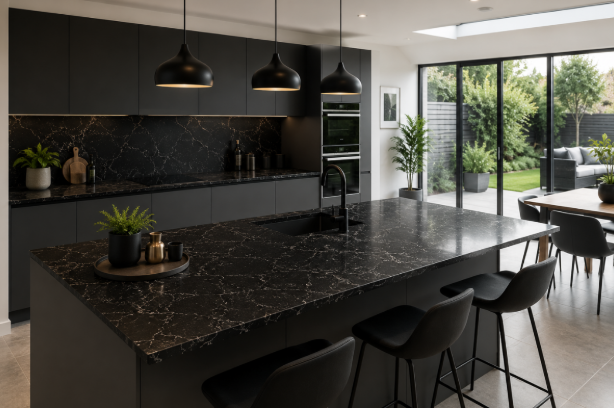
Marble has long been associated with elegant kitchens, but natural stone is not always the most practical choice for a busy home. A marble effect quartz worktop offers a different route by combining the visual appeal of veined stone with the consistency and lower-maintenance characteristics of engineered quartz.
For homeowners planning a kitchen renovation, the key is understanding how marble-look quartz differs from natural marble, which patterns work best in different spaces, and what to consider before ordering a slab. Colour, veining, thickness, edge profile, lighting, cabinetry and everyday maintenance can all affect the final result.
What Is a Marble Effect Quartz Worktop?
A marble effect quartz worktop is an engineered surface designed to recreate the appearance of marble through a controlled pattern of veins, movement and tonal variation.
Unlike natural marble, which is cut directly from quarried stone, quartz worktops are manufactured using mineral content combined with binders and pigments. This gives designers greater control over colour consistency and pattern.
The result can range from subtle grey veining on a white background to more dramatic patterns inspired by well-known marble styles.
For homeowners who like the look of marble but want a more predictable surface, quartz can be an attractive alternative.
Why Do Homeowners Choose Marble-Look Quartz?
The main reason is visual impact.
A marble-effect quartz worktop can create a bright, refined surface without requiring the exact maintenance routine associated with some natural stones.
It can also provide greater consistency from one slab to another. Natural marble varies considerably because every piece is unique, while engineered quartz is designed to reproduce a more controlled aesthetic.
This can make it easier to coordinate multiple worktop sections, kitchen islands and splashbacks.
Quartz is also generally non-porous, which means it does not usually require sealing in the same way many natural stone surfaces do.
How Does It Compare With Natural Marble?
The most obvious difference is composition.
Natural marble is a geological material with unique mineral patterns, while a marble effect quartz worktop is manufactured to imitate that appearance.
Natural marble develops character through variation, but it can also be more susceptible to staining, etching and surface marks depending on use and finish.
Quartz generally offers stronger consistency and simpler routine maintenance.
However, buyers should not assume quartz is indestructible. It can still be damaged by excessive heat, heavy impact or improper cleaning products.
The better choice depends on whether the homeowner prioritises natural variation or everyday practicality.
Choose Veining to Match the Size of the Kitchen
Veining has a major influence on the way a worktop looks.
Large, dramatic veins can create a strong focal point on an island or expansive countertop. Finer veining may suit smaller kitchens where heavy patterns could feel visually crowded.
A marble effect quartz worktop with subtle movement can also make it easier to coordinate with patterned flooring or decorative cabinetry.
Before choosing a slab, think about how much worktop will actually be visible after appliances, sinks and accessories are installed.
A pattern that looks understated in a small sample can feel much more dramatic across a full kitchen surface.
Consider the Background Colour Carefully
Not all marble-look quartz is bright white.
Some surfaces have warmer cream or ivory backgrounds, while others lean toward cool white or light grey.
The background colour of a marble effect quartz worktop should work with surrounding materials rather than being selected independently.
Warm cabinetry may pair better with softer off-white tones, while crisp white or grey kitchens can suit cooler surfaces.
Lighting matters too. Natural daylight can reveal undertones that are difficult to see under artificial showroom lighting.
Whenever possible, compare samples in the actual kitchen before making a final decision.
Edge Profiles Change the Finished Look
The edge is easy to overlook, but it affects the overall style of the worktop.
Simple straight edges can suit modern kitchens, while more detailed profiles may work with traditional cabinetry.
A marble effect quartz worktop often looks particularly clean with a simple edge because it allows the veining to remain the main visual feature.
Thickness also affects the appearance.
A thicker-looking worktop can feel more substantial, while slimmer profiles create a lighter and more contemporary effect.
The best choice depends on cabinet proportions and the overall design direction of the room.
Use Vein Direction Deliberately
Vein direction becomes especially important when the worktop includes a large island or waterfall end.
Fabricators may need to plan how patterns meet at seams and corners.
A marble effect quartz worktop can look more convincing when the veining flows logically across adjoining sections.
Poorly placed seams can interrupt the pattern and make the surface feel less natural.
This is why templating and slab layout should be discussed before fabrication rather than after cutting has begun.
If the pattern is highly directional, ask how joints, returns and splashbacks will align.
Think About Splashbacks and Upstands
A marble-look worktop can also influence the choice of wall finish.
Some homeowners continue the same quartz material up the wall to create a coordinated splashback. Others combine it with tiles, painted walls or glass.
Using the same marble effect quartz worktop material vertically can create a seamless appearance, particularly behind a hob or sink.
However, this approach may increase material and fabrication costs.
A more economical option is to use a short upstand and pair it with a simpler wall finish.
The right choice depends on budget and how much visual continuity is desired.
Pairing With Cabinet Colours
Marble-look quartz is versatile because it can work with many cabinetry colours.
White cabinets create a light, minimal appearance, while dark blue, charcoal or black cabinetry can create stronger contrast.
Wood tones can bring warmth to a marble-effect quartz worktop, particularly when the veining has subtle beige or brown undertones.
Green cabinetry can also work well when paired with warm metallic details.
The goal should be balance. If the worktop pattern is already dramatic, simpler cabinet finishes can prevent the space from feeling overly busy.
Is Quartz Easy to Maintain?
Routine care is generally straightforward.
For everyday cleaning, a soft cloth with mild soap and water is usually sufficient. Spills should still be wiped promptly, particularly substances with strong colour or oil content.
A marble effect quartz worktop does not normally require regular sealing, which is one reason many households find it convenient.
Harsh abrasives and aggressive chemicals should be avoided unless the manufacturer specifically confirms they are suitable.
Using cutting boards and trivets also helps protect the surface from scratches and heat exposure.
Good habits can preserve both appearance and finish over the long term.
Heat Protection Still Matters
Quartz may feel extremely solid, but high temperatures can still create problems.
Hot pans, oven trays and cookware should not normally be placed directly onto a marble effect quartz worktop.
Using trivets or heat-resistant mats reduces the risk of thermal damage or discolouration.
This is particularly important around hobs and ovens where cookware is frequently moved.
Quartz is designed for normal kitchen use, but sensible heat protection remains part of good maintenance.
Durability should not be confused with immunity from damage.
Samples Are More Useful Than Online Images
Photographs can help narrow down styles, but they do not always represent colour and scale accurately.
Screen settings, photography lighting and image editing can all change how quartz appears.
Before ordering a marble effect quartz worktop, obtain physical samples where possible and compare them with cabinets, flooring and paint colours.
For heavily veined designs, viewing a full slab can be even more important because a small sample may show only one part of the pattern.
This is particularly useful when choosing a statement surface for a large kitchen island.
Think About Long-Term Design Appeal
Worktops are expensive and disruptive to replace, so they should ideally suit the kitchen for many years.
Very dramatic patterns can create a strong design statement, while softer veining may be easier to adapt if cabinet colours or décor change later.
A marble effect quartz worktop in a restrained pattern can offer flexibility while still providing the elegance associated with natural stone.
The best option is not necessarily the most fashionable slab at the time of purchase.
It is the surface that works with the architecture, lighting and materials of the kitchen as a whole.
Conclusion
A marble effect quartz worktop can offer the visual character of veined stone while providing the consistency and straightforward maintenance associated with engineered quartz. Choosing the right option involves looking beyond colour and considering vein scale, slab layout, edge profile, cabinetry, lighting, heat protection and installation details. Surfaces such as Unistone Bianco Cristal Quartz can be considered within this broader design approach when homeowners want a pale, stone-inspired finish that works across contemporary or transitional interiors. Careful sampling and layout planning are especially important. When the worktop is chosen in relation to the entire kitchen rather than as an isolated surface, marble-effect quartz can create a cohesive finish that remains practical for everyday use.





Most Commented Posts