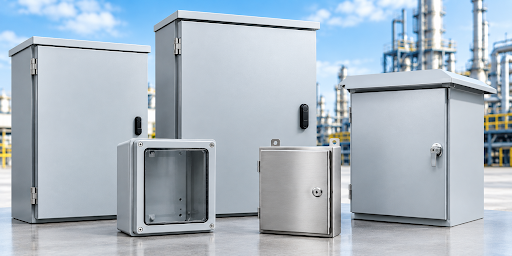
Electrical equipment can operate in environments ranging from clean indoor rooms to demanding industrial and outdoor locations. Dust, rain, snow, oil, moisture, and corrosive substances can all affect electrical components when they are not adequately protected. This is why understanding NEMA box ratings is important when selecting an enclosure for a particular installation.
The National Electrical Manufacturers Association uses enclosure Types to describe the environmental protection an enclosure is designed to provide. ANSI/NEMA 250 establishes classifications and testing requirements that help users determine the appropriate enclosure Type for an application.
Knowing what these classifications mean can make enclosure selection more precise and help avoid choosing protection that is either insufficient or unnecessarily extensive.
What Are NEMA Box Ratings?
NEMA box ratings are classifications used to identify the environmental conditions an electrical enclosure is designed to withstand. They can address factors such as solid foreign objects, water exposure, oil, coolants, corrosion, and other environmental hazards, depending on the specific Type.
NEMA 250 covers enclosure Types for electrical equipment rated up to 1,000 volts. The standard’s purpose is to help users determine which enclosure Type is appropriate for an application, what features it should have, and what testing is used to demonstrate conformity.
The rating therefore provides more information than simply describing an enclosure as suitable for indoor or outdoor use.
Why Do NEMA Box Ratings Matter?
The operating environment has a direct influence on the protection an electrical enclosure needs. An enclosure installed inside a dry building may face very different conditions from equipment positioned outdoors or in a manufacturing facility.
For example, NEMA Type 1 is intended for indoor applications and provides protection against access to hazardous parts and falling dirt. Type 3 is designed for indoor or outdoor use and addresses conditions including rain, sleet, snow, and windblown dust. Type 3R also addresses rain, sleet, and snow while providing a different level of protection against solid foreign objects.
Selecting the appropriate Type therefore begins with understanding the environment in which the enclosure will be installed.
Common NEMA Types and Their Applications
Different NEMA box ratings correspond to different environmental requirements.
Type 1
Type 1 is generally intended for indoor locations. It provides protection against accidental access to hazardous electrical parts and against falling dirt entering the enclosure.
Type 2
Type 2 is also intended for indoor applications but provides additional protection against dripping and light splashing water.
Type 3
Type 3 is designed for indoor or outdoor locations where protection from falling dirt, windblown dust, rain, sleet, and snow is required.
Type 3R
Type 3R is also suitable for indoor or outdoor use and provides protection against rain, sleet, and snow. It is commonly considered where these weather conditions are the primary environmental concerns.
Type 4
Type 4 provides protection against specified solid foreign objects and water exposure, including rain, splashing water, and hose-directed water.
Type 4X
Type 4X includes the applicable Type 4 protection while adding requirements associated with corrosion resistance. This can be important in environments where corrosive conditions are present.
NEMA’s published enclosure information provides definitions for these and other enclosure Types, while ANSI/NEMA 250 provides the underlying classification and testing framework.
How Do You Choose the Correct Rating?
Choosing an enclosure Type should begin with an assessment of the installation environment. Determine whether the equipment will be indoors or outdoors and identify potential exposure to water, dust, snow, oil, chemicals, corrosive materials, or other contaminants.
The equipment being housed also needs consideration. Dimensions, cable-entry arrangements, mounting requirements, accessibility, and heat management can influence the enclosure specification.
Installation practices are important as well. NEMA notes that certain Type-rated enclosures have specific requirements concerning mounting methods and field modifications. The final installation can also be subject to approval by the Authority Having Jurisdiction.
Consequently, the enclosure should be evaluated as part of the complete electrical installation rather than selected according to its rating alone.
NEMA Ratings and IP Ratings
NEMA classifications are sometimes compared with IP ratings, but the two systems are not identical. IP ratings under IEC 60529 primarily describe protection against solid particles and water.
NEMA Types can address additional environmental considerations, including corrosion, oil, coolants, icing, and other conditions. NEMA therefore states that IP ratings should not be treated as direct substitutes for NEMA Type ratings in U.S. electrical installations where a NEMA Type is required.
Understanding this distinction is particularly useful when equipment specifications include both NEMA and IP terminology.
Where Are NEMA-Rated Boxes Used?
NEMA-rated electrical enclosures can be used in manufacturing facilities, commercial buildings, automation systems, control installations, utility applications, outdoor electrical systems, and industrial environments.
The appropriate Type depends on the hazards and conditions expected at the installation location. A clean indoor application may require considerably different protection from equipment exposed to heavy rain, dust, corrosive substances, or industrial liquids.
The enclosure’s construction, mounting method, cable entries, and intended application should therefore be considered alongside the environmental classification.
Conclusion
Understanding NEMA box ratings makes it easier to identify the environmental protection required for a particular electrical installation. The classifications provide a structured way to evaluate factors such as water, dust, weather, corrosion, and other conditions that could affect enclosed equipment. When selecting NEMA enclosures, the decision should be based on the actual installation environment, the equipment being housed, required access, mounting arrangements, and applicable standards rather than simply choosing the highest available rating. Reviewing the manufacturer’s specifications and relevant NEMA requirements can help ensure the selected enclosure is appropriate for its intended use.







Most Commented Posts