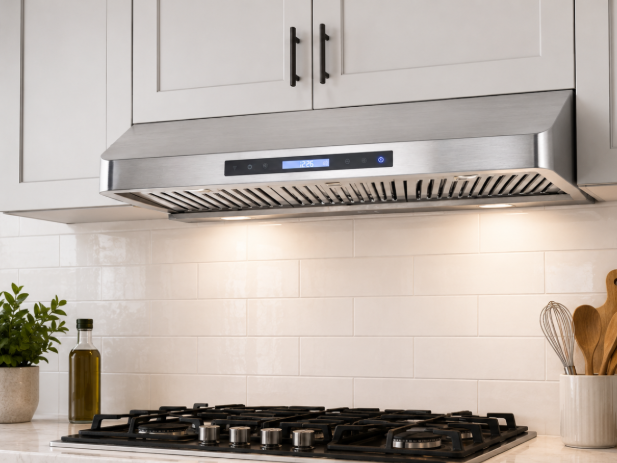
Kitchen ventilation helps control smoke, steam, grease, heat, and odors generated during cooking. For kitchens with limited space or existing upper cabinetry, an under-cabinet hood can provide ventilation without requiring a large chimney-style structure. Choosing the correct size and configuration, however, requires attention to more than width.
An under cabinet vent hood 30 inch is designed to fit beneath a cabinet above a compatible cooking surface. This size can work well for many standard residential cooktops, but homeowners should also consider airflow, ducting, hood depth, mounting height, filter design, noise, and cooking habits. Current 30-inch under-cabinet systems are available with different airflow capacities and venting configurations, including options designed for top or rear ducting.
What Is an Under-Cabinet Range Hood?
An under-cabinet range hood is installed beneath an existing kitchen cabinet positioned above a range or cooktop. Unlike a wall-mounted canopy hood, it is integrated into the cabinet layout and generally takes up less visual space.
This makes the design useful for kitchens where cabinet storage needs to be preserved. It can also simplify replacement projects when an existing under-cabinet hood is being upgraded.
Depending on the model, an under-cabinet hood can be ducted to the outdoors or configured for recirculating operation. Ducted systems remove cooking air through an exhaust route, while recirculating systems filter the air and return it to the kitchen.
Why Does a 30-Inch Width Matter?
The hood should provide sufficient coverage over the cooking surface. A 30-inch hood is commonly designed around standard residential cooking appliances of a similar width.
The goal is to position the intake area over the active cooking zones so that smoke and steam can be captured before they spread underneath surrounding cabinets.
Current 30-inch under-cabinet guidance notes that the intake opening is aligned with the usable cooking area of standard residential cooktops. It also recommends considering a wider hood when the cooking surface exceeds 30 inches.
Before purchasing, homeowners should measure the actual cooktop width as well as the cabinet opening. The hood must fit securely while maintaining the clearances specified by the manufacturer.
How Much CFM Do You Need?
CFM, or cubic feet per minute, describes the volume of air a ventilation fan can move. It is an important specification, but selecting the highest available CFM does not necessarily guarantee better ventilation.
The appropriate airflow depends on the cooking appliance, cooking methods, frequency of use, duct configuration, and kitchen layout. Standard cooking may require less ventilation than frequent frying, searing, stir-frying, or other high-heat techniques.
Current 30-inch under-cabinet models can span a broad airflow range, with some configurations offering between 600 and 1,700 CFM.
However, the home’s ventilation system and ductwork must be capable of supporting the selected airflow. Larger exhaust systems can also create pressure-related considerations in tightly sealed homes.
The EPA notes that larger kitchen exhaust fans may require makeup air to prevent excessive depressurization and potential combustion-appliance backdrafting.
Should You Choose Ducted or Ductless?
This is one of the most important decisions when selecting a kitchen hood.
A ducted hood carries cooking air through a duct and exhausts it outdoors. This approach physically removes smoke, moisture, grease particles, and odors from the kitchen.
A ductless hood instead passes air through filters before returning it to the room. This can be useful where exterior ducting is not possible, but it does not provide the same type of outdoor air removal.
The EPA recommends using a range hood that vents outdoors when available. It also recommends operating the hood while cooking and leaving it on for 10–20 minutes afterward.
For households that frequently cook foods that generate smoke or grease, outdoor exhaust can be particularly useful.
What Should You Know About Ductwork?
A hood’s rated CFM is only part of its ventilation performance. The duct system also affects how efficiently air can move from the hood to the exterior.
Long duct runs, multiple bends, restrictive transitions, and undersized ducts can increase resistance. Therefore, homeowners should check the hood’s duct diameter requirements before installation.
Some 30-inch under-cabinet models provide rear venting as well as conventional top venting. Rear venting can allow the duct to travel horizontally through an exterior wall instead of vertically through the cabinet.
This can be useful when cabinet storage needs to remain intact, but the wall behind the cooking appliance must be suitable for the duct route.
Does Hood Depth Matter?
Width is easy to measure, but hood depth also affects capture performance.
Cooking emissions from front burners can move forward as they rise. A hood that does not extend sufficiently toward the front of the cooking surface may have more difficulty capturing these emissions.
Homeowners should therefore compare the hood’s depth with the cooktop dimensions and follow the manufacturer’s installation recommendations.
This is especially important for cooking styles that produce substantial smoke, such as frying or high-temperature searing.
How High Should an Under-Cabinet Hood Be Installed?
Installation height affects both safety and ventilation performance.
A hood installed too low can interfere with cooking and may not meet the required clearance for the appliance. Installing it too high can reduce its ability to capture smoke and steam before they disperse.
There is no single height that applies to every hood and cooking appliance. The manufacturer’s specifications and applicable local requirements should always take priority.
Current guidance for 30-inch under-cabinet models commonly places installation around 28–36 inches above the cooktop, while emphasizing that manufacturer instructions and local codes should be followed.
What Is a Wall-Mounted Ducted Range Hood?
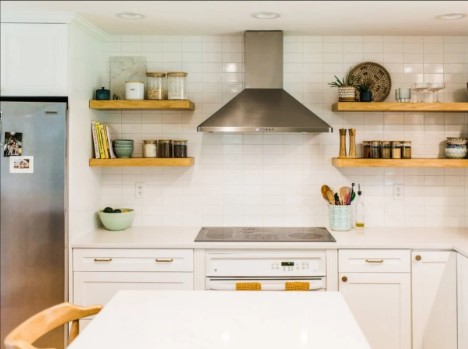
A wall mounted ducted range hood is installed directly against the wall above a cooking appliance and uses ductwork to exhaust air outdoors.
Unlike an under-cabinet hood, a wall-mounted model generally does not require an upper cabinet directly above the range. Instead, it often features a canopy or chimney structure extending upward toward the ceiling.
This configuration can provide a prominent ventilation solution for kitchens where the cooking appliance is located against a wall and cabinet storage above the range is not required.
The two configurations serve different design needs. Under-cabinet models prioritize integration with existing cabinetry, while wall-mounted ducted hoods can provide a larger visual and physical structure around the ventilation area.
Under-Cabinet vs. Wall-Mounted Hoods
The choice between the two depends largely on the kitchen’s layout.
Under-Cabinet Hood
An under-cabinet hood may be preferable when:
- Existing upper cabinets need to remain
- Kitchen space is limited
- A compact installation is preferred
- The cooktop is a standard residential size
- Cabinet-integrated ventilation fits the design
Wall-Mounted Ducted Hood
A wall-mounted ducted model may make more sense when:
- There is no cabinet above the range
- A larger cooking surface requires broader coverage
- A visible hood is part of the kitchen design
- Exterior ducting is already available
- The homeowner wants a larger canopy-style ventilation system
Neither design is universally better. The cooking appliance, kitchen dimensions, duct route, and desired installation all matter.
How Do Cooking Habits Affect Hood Selection?
Cooking style can significantly influence ventilation requirements.
Boiling and simmering may produce relatively modest amounts of airborne grease, while frying, searing, stir-frying, and grilling can generate substantially more smoke and particles.
The EPA identifies cooking as an important source of indoor particulate matter and recommends using exhaust ventilation while cooking.
Using the back burners when possible can also improve capture because they are positioned closer to the hood’s intake area. Keeping the hood running for several minutes after cooking helps remove residual pollutants.
What Maintenance Does an Under-Cabinet Hood Need?
Regular maintenance is essential for maintaining airflow and reducing grease accumulation.
Filters should be cleaned according to the manufacturer’s instructions. Some current under-cabinet models use removable, dishwasher-safe filters, while ductless configurations may require periodic charcoal or carbon-filter replacement.
The exterior surface should also be wiped regularly, particularly around areas where grease and steam accumulate.
For ducted systems, homeowners should pay attention to unusual reductions in airflow or changes in fan noise. These can indicate filter buildup, duct restrictions, or another maintenance issue.
What Should You Check Before Installation?
Before purchasing a 30-inch under-cabinet hood, homeowners should verify:
- Cabinet opening dimensions
- Cooktop width and depth
- Hood depth
- Required installation height
- CFM requirements
- Duct diameter
- Top or rear venting options
- Electrical requirements
- Filter type
- Noise specifications
- Local code requirements
- Outdoor termination location
Taking these measurements before purchasing can prevent installation problems and reduce the need for cabinet modifications.
Conclusion
An under cabinet vent hood 30 inch can be a practical ventilation solution for kitchens where cabinet space and compact dimensions are important. Its effectiveness depends on appropriate sizing, sufficient airflow, correct installation height, suitable ductwork, and regular maintenance. For homeowners without an upper cabinet above the range, a wall mounted ducted range hood offers a different configuration that can accommodate larger cooking areas while exhausting cooking air directly outdoors. The choice ultimately depends on the kitchen layout, cooking appliance, available duct route, and desired installation style. Good kitchen ventilation is not determined by hood size alone. Matching the hood to the cooking surface, planning the ductwork carefully, maintaining the filters, and using the system consistently can help control smoke, grease, moisture, and odors during everyday cooking.




Most Commented Posts