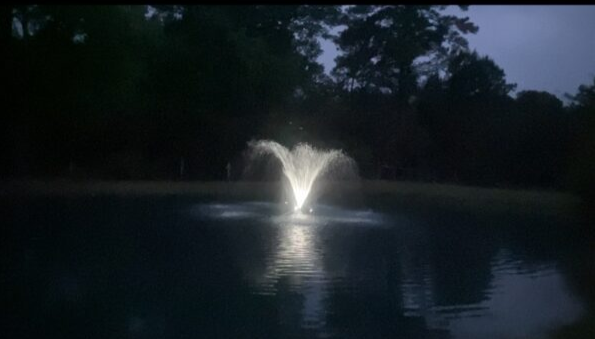
Older garden lighting often meant hot bulbs, frequent replacements, and surprising electric bills. Pond owners now have far better options, and the change comes down to the light source itself. Water fountain LED lights use solid-state technology that suits wet, outdoor conditions better than the halogen bulbs they replaced.
How LED Technology Differs
A halogen bulb produces light by heating a filament, which wastes much of the power as heat. An LED produces light through a semiconductor, so most of the energy becomes light and far less becomes heat. One pond-lighting source notes that LEDs convert 80 percent or more of their energy into light.
Cooler operation matters in water. Halogen units can warm the surrounding water, which is a concern in small ponds with fish. LED fixtures stay cool, so they can sit close to the spray, plants, and liner without causing damage.
Energy Use and Running Costs
The power difference is large. Pond-lighting comparisons list LED fixtures at roughly 8 to 20 watts against 29 to 72 watts for halogen, and larger pool-grade comparisons show 15 to 35 watts for LED against 300 to 500 watts for halogen. Many accent fixtures for fountains draw only 1 to 10 watts.
One example from a pond-lighting guide shows a layout of ten 6-watt LED fixtures drawing 60 watts. Run for 5 hours a night over a 180-night season, that system uses about 54 kWh. At an electricity rate of $0.14 per kWh, the season costs roughly $7.56. Replacing ten 12-watt halogens with 4-watt LEDs saves about 175 kWh per year under the same assumptions.
Lifespan and Maintenance
| Feature | LED | Halogen |
| Typical wattage | 1–35 W | 29–500 W |
| Rated lifespan | 25,000–50,000 hours | 1,000–4,000 hours |
| Heat output | Low | High |
| Bulb replacement | Rare | Frequent |
At 6 hours of use per night, a 25,000 to 50,000 hour rating translates to roughly 11 to 22 years before the LED reaches 70 percent of its original brightness, a standard benchmark known as L70. Real-world life also depends on driver quality, housing material, and seal design. A good water fountain LED lights installation avoids the chore of climbing into a pond to change a burned-out bulb.
Waterproofing and Voltage
Fixtures for permanent submersion should carry an IP68 rating, which indicates protection from continuous immersion. IP67 covers temporary immersion only, so it is a weaker match for fixtures that sit underwater every night. Seals and gaskets determine whether the rating holds up over time.
Most systems run on 12 volts through a transformer, which lowers shock risk compared with mains-voltage fixtures. LEDs also let owners add more fixtures without exceeding transformer capacity. A common transformer for a medium pond is 100 to 200 watts, which can support roughly 10 to 20 low-wattage LED units depending on spacing. Plug the transformer into a GFCI-protected outlet and disconnect power before servicing any fixture.
Choosing Features That Matter
When comparing products, look beyond the watt figure. Lumens measure actual light output, while watts only show how much power the unit draws. The following specifications help narrow the field:
- IP68 rating for continuous submersion.
- Lumen output suited to spray height.
- Color temperature, with warm white around 2700K to 3000K for a natural look.
- Beam angle, narrow for tall sprays and wide for low displays.
- Single-color or color-changing options.
- Cable length and gauge for the planned distance.
Kits made for small decorative fountains often include three LED fixtures with a combined load of about 6 watts and a long power cord. Larger displays call for higher-output units. Matching the fixture to the spray avoids both dim results and glare.
Care and Longevity
Even durable LEDs need basic care. Wipe algae and mineral film off the lenses every few weeks, since buildup cuts light output. Inspect cables for cracks, check seals after winter, and keep connections waterproof. A timer or photocell limits unnecessary run time and further extends the life of the fixtures.
Conclusion
LED technology gives pond owners lower running costs, cooler operation, and a lifespan measured in decades, which is why it has replaced halogen in most new installs. Choosing the right IP rating, voltage, and output keeps the system safe and effective. Owners with bigger water features, including floating fountains for large ponds, benefit most from the low wattage, since many fixtures can share a single transformer. Planning the system carefully will keep it dependable for years.





Most Commented Posts