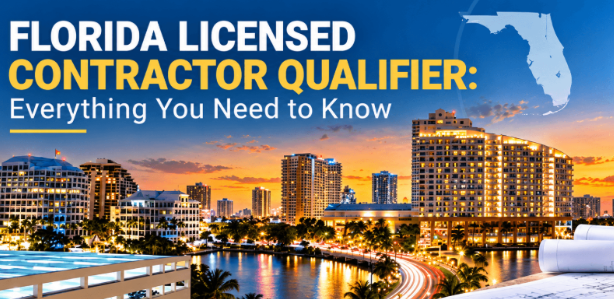
Florida is one of the busiest construction markets in the country, shaped by population growth, commercial development, and constant demand for renovations and storm repairs. Before a company can legally take on that work, however, it needs a qualifying agent attached to its license. Understanding how a license contractor qualifier Florida companies depend on fits into the state’s regulatory system helps both businesses and licensed professionals avoid costly mistakes and delays. This blog post explains who regulates contractor licensing, which license types require a qualifier, what it takes to qualify, and how the role is structured under Florida state law.
Who Regulates Contractor Licensing
Florida’s construction licensing is governed primarily by the Construction Industry Licensing Board (CILB), which operates under the Department of Business and Professional Regulation (DBPR). The CILB oversees most major trades, including general contractors, building contractors, and several specialty categories. The state uses the term qualifying agent in its statutes and defines this person as the primary agent for the contractor’s license. For the license contractor qualifier Florida role, those credentials allow the company to operate, pull permits, and bid on projects.
License Types That Require a Qualifier
Most contractor license categories in Florida require a qualifying agent. The Certified General Contractor license is the most versatile and covers commercial, residential, and industrial construction. The Certified Residential Contractor license is narrower and covers single-family homes, duplexes, and certain multi-family residential buildings up to a specific size. Roofing is a standalone category: the Certified Roofing Contractor license. Electrical contractors hold a license from their own board, while plumbing and mechanical or HVAC work require Certified Plumbing and Certified Mechanical or HVAC contractor licenses.
What It Takes to Qualify
A Florida contractor qualifier must meet several requirements before serving in the role. Exams typically have two parts: a trade exam covering construction methods, building codes, and safety, and a business and finance exam covering contract law, project management, financial management, and Florida construction lien law. Most license categories require at least four years of experience in the trade, with some of that time at a supervisory or management level. Florida also requires a credit report and financial statements, and the DBPR reviews criminal history, since certain convictions can disqualify a candidate. Applicants should plan ahead, because the DBPR can take 45 to 60 days to process a license.
Employment and Supervision
The qualifier’s relationship with the company is defined closely by state law. The qualifier must be a permanent W-2 employee or an officer of the company, not an independent contractor lending a name to the license. Arrangements without genuine employment and oversight are considered license renting, which is illegal under Florida Statute Chapter 489. The qualifying agent is responsible for supervising and controlling all operations that fall under the license, so anyone considering the license contractor qualifier Florida role should expect real involvement in active projects and compliance questions.
Multiple Companies and Local Rules
Florida allows a qualifying agent to qualify up to three companies. For additional companies, the qualifier must show 20 percent or more ownership, W-2 employment, or other evidence of direct control over construction operations, and qualifying three businesses requires an appearance before the CILB. Local rules add another layer. Miami-Dade and Broward counties fall under the High-Velocity Hurricane Zone, where design wind speeds reach up to 195 mph, and building products must carry valid Notice of Acceptance or Florida Product Approval documentation. Orange County may also require a Contractor Competency Card to pull permits for certain trades.
Conclusion
The qualifying agent role connects a company’s work to the state’s licensing system, and the rules around it are specific. Qualifiers need the right license category, documented experience, passing exam results, a genuine employment relationship, and real supervision of the work performed. Anyone planning to pursue a Florida contractor license should also account for processing times and local requirements that vary by county and city. Because rules can change, readers should verify current requirements with the DBPR and Chapter 489 before making decisions.





Most Commented Posts