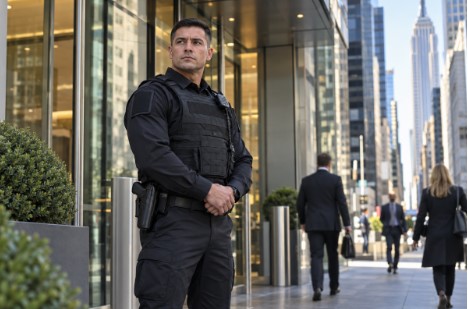
Security requirements vary significantly depending on the property, people being protected, potential threats, and operating environment. For businesses, residential properties, executives, and high-value locations, professional armed security services can provide a visible security presence alongside established safety procedures. In New York, armed security is also subject to specific state registration, training, and firearms requirements, making professional qualifications an important consideration when selecting a security provider.
What Are Armed Security Services?
Armed security services involve trained and appropriately registered security professionals who are authorized to carry firearms while performing security duties. Their responsibilities can include monitoring property, controlling access, observing suspicious activity, protecting valuable assets, documenting incidents, and supporting emergency responses.
The specific responsibilities should be established according to the site’s risks and operational requirements. Ace Protection & Services, for example, describes armed guard responsibilities that include high-risk site protection, restricted-area monitoring, cash-handling security, suspicious-activity response, emergency support, and executive protection.
New York Training and Registration Requirements
New York has specific requirements for individuals working as armed security guards. The Department of State requires security guards to be registered and complete applicable training through approved programs.
For an armed security guard, initial requirements include an 8-hour pre-assignment course, 16 hours of on-the-job training within 90 days of employment, and a 47-hour firearms training course. Applicants must possess a valid New York State pistol permit to enroll in the firearms course. Armed guards must also complete 8-hour annual in-service training and 8-hour annual firearms training each year.
These requirements make licensing and training verification important when evaluating a security company.
Where Armed Security May Be Used
Armed security can be appropriate for environments where the potential consequences of a security incident warrant a higher level of protection. Common applications include:
- Corporate and commercial properties
- Construction and industrial sites
- High-value facilities
- Financial and cash-handling locations
- Residential properties
- Special events
- Executive and VIP protection
- Restricted-access facilities
The appropriate level of protection depends on the site’s vulnerabilities and the nature of the risks involved. A professional security assessment can help determine whether armed personnel, unarmed guards, mobile patrols, surveillance, access control, or a combination of measures is appropriate.
Armed Security and Executive Protection
Personal protection requires a different approach from protecting a stationary property. Individuals with elevated security concerns may require advance planning, controlled movement, secure transportation, monitoring, and coordination with other security personnel.
A guard may therefore perform responsibilities that extend beyond simply remaining near a client. Executive protection can involve assessing locations and routes, managing arrivals and departures, maintaining situational awareness, and supporting emergency procedures. Ace Protection & Services lists executive protection and bodyguard services among its New York security offerings.
How to Evaluate a Security Provider
Before selecting a security company, organizations should examine several factors. First, verify that the provider operates in compliance with New York State licensing requirements. It is also useful to ask about guard qualifications, training, supervision, insurance, experience with similar assignments, reporting procedures, and emergency-response protocols.
The provider should understand the specific property or individual’s requirements rather than applying the same security plan to every assignment. Clear communication regarding coverage hours, responsibilities, access procedures, escalation protocols, and incident reporting can help create a more consistent security operation.
Conclusion
Effective security begins with matching protection measures to the actual risks of a property, business, event, or individual. Properly trained and registered professionals can contribute to deterrence, monitoring, emergency support, and incident documentation. Body guard in NYC. When evaluating, organizations should consider licensing, training, experience, supervision, and the provider’s ability to develop a security plan suited to the assignment. For personal protection, executive-focused services can provide additional planning and support based on the individual’s circumstances.



Most Commented Posts