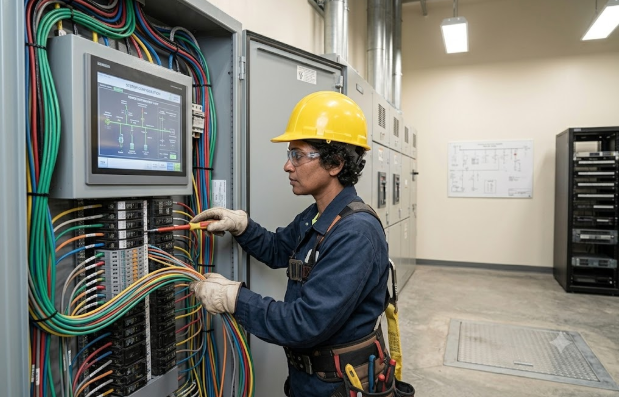
A home’s electrical panel distributes power to circuits throughout the property, so its condition directly affects reliability and safety. As electrical demand increases from air conditioning, electric appliances, EV chargers, home offices, and other equipment, an older panel may no longer provide the capacity or functionality a household needs. Electrical panel replacement may be appropriate when a panel is damaged, obsolete, undersized, or unable to support planned electrical improvements. Because panel work involves high-voltage service equipment, it should be evaluated and completed by a qualified electrician rather than treated as a do-it-yourself repair.
What Does an Electrical Panel Do?
The electrical panel is the central distribution point for electricity entering a home.
Power from the utility service reaches the panel and is divided into individual branch circuits protected by breakers or, in some older systems, fuses.
A typical panel serves circuits for:
- Lighting
- Receptacles
- Kitchen appliances
- HVAC equipment
- Water heaters
- Laundry equipment
- Garages
- Outdoor circuits
When considering electrical panel replacement, homeowners should understand that the panel is only one part of the electrical service. The service conductors, meter equipment, grounding system, and utility connection may also affect the scope of an upgrade.
What Are the Signs a Panel May Need Replacement?
Not every electrical problem means the entire panel must be replaced.
However, certain symptoms deserve professional evaluation.
Possible warning signs include:
- Breakers that trip repeatedly
- Burning odors
- Buzzing or crackling sounds
- Visible corrosion
- Heat around the panel
- Damaged breaker connections
- Scorch marks
- Lack of available breaker spaces
- An outdated fuse-based system
If these conditions are present, an electrician can determine whether a repair is sufficient or whether electrical panel replacement is the safer long-term option.
Why Do Breakers Keep Tripping?
Circuit breakers are designed to interrupt power when electrical conditions become unsafe.
A breaker that occasionally trips because too many devices are operating on one circuit may simply indicate an overloaded branch circuit.
Repeated tripping can also result from:
- Short circuits
- Ground faults
- Damaged wiring
- Faulty appliances
- Loose electrical connections
- Undersized circuits
A larger panel does not automatically solve these issues.
Before recommending electrical panel replacement, an electrician should identify why breakers are tripping and determine whether the problem involves the panel, the individual circuit, or connected equipment.
Does an Older Home Automatically Need a New Panel?
No.
Age alone does not determine whether a panel must be replaced. An older electrical system may still function properly if it has been maintained and remains suitable for current electrical demand.
However, older homes are more likely to have limited service capacity, outdated components, previous modifications, or insufficient circuit space.
A professional inspection can assess:
- Panel condition
- Breaker compatibility
- Service capacity
- Grounding and bonding
- Wiring condition
- Available circuit spaces
- Planned electrical loads
This helps determine whether electrical panel replacement is actually needed instead of replacing equipment based solely on its age.
Why Is Electrical Capacity Important?
Electrical service capacity determines how much load the home can support.
Older homes may have been designed when households used far fewer high-demand electrical appliances.
Today, homeowners may need power for:
- Central air conditioning
- Electric ranges
- Heat pumps
- Pool equipment
- Electric water heaters
- EV charging
- Workshops
- Additional refrigerators or freezers
If several major loads are being added, electrical panel replacement may become part of a broader service upgrade.
The correct capacity should be determined through an electrical load calculation rather than guesswork.
What Is a Load Calculation?
A load calculation estimates the electrical demand of a property.
Electricians use it to determine whether the existing service can support current and planned equipment.
The calculation may consider:
- Home size
- General lighting and receptacle loads
- Kitchen appliances
- HVAC systems
- Water heating
- Laundry equipment
- EV charging
- Other fixed electrical loads
This step is important because simply installing a larger panel does not necessarily increase the amount of power available from the utility.
A proper electrical panel replacement project should account for the complete electrical service.
Can a New Panel Add More Breaker Space?
Yes, in many cases.
Modern households often need more dedicated circuits than older panels were designed to accommodate.
Additional breaker space may be useful for:
- Kitchen remodeling
- Home additions
- Workshops
- Outdoor equipment
- EV chargers
- Solar-related equipment
- New HVAC systems
However, additional physical space does not mean unlimited electrical capacity.
During electrical panel replacement, both the number of circuit positions and the total service capacity must be considered.
Is a Larger Panel Always Better?
Not necessarily.
Installing equipment with a higher ampere rating does not automatically mean a property should use that full capacity.
The electrical service should be sized according to load requirements, local code, equipment specifications, and utility limitations.
Oversizing unnecessarily can increase project cost without providing a meaningful benefit.
The purpose of electrical panel replacement should be to create a safe, appropriately sized system that supports current and reasonably anticipated future demand.
Can an Electrical Panel Upgrade Support EV Charging?
Potentially.
Electric vehicle charging can create a significant new electrical load, particularly when installing higher-powered Level 2 charging equipment.
Before installation, an electrician should determine whether the existing service has enough available capacity.
Possible solutions may include:
- Adding a dedicated circuit
- Installing load-management equipment
- Upgrading service capacity
- Replacing the panel
- Modifying other electrical loads
For some homes, electrical panel replacement may be part of preparing the electrical system for EV charging, but it is not required in every situation.
What Happens During Panel Replacement?
The exact process depends on the property and project scope.
Typical work may include:
- Evaluating the existing electrical service.
- Obtaining required permits.
- Coordinating utility disconnection when necessary.
- Removing the old panel.
- Installing the new equipment.
- Reconnecting existing circuits.
- Updating grounding or bonding where required.
- Labeling circuits.
- Completing inspections.
- Restoring electrical service.
Because the incoming service conductors can remain hazardous even when branch breakers are off, electrical panel replacement requires specialized training and equipment.
How Long Does the Work Take?
Project length varies.
A straightforward panel replacement may be completed within a working day in some situations, while more complex projects can take longer.
Factors affecting the schedule include:
- Utility coordination
- Permit requirements
- Service entrance modifications
- Grounding updates
- Existing wiring condition
- Panel location
- Number of circuits
- Inspection requirements
Homeowners should expect at least some period without electricity during electrical panel replacement.
Planning for refrigeration, internet access, medical equipment, and home-based work can make the interruption easier to manage.
Why Do Permits and Inspections Matter?
Electrical panel work can affect the entire electrical system, so local permitting and inspection requirements are important.
Permits help ensure that work is reviewed according to applicable electrical and building requirements.
An inspection may verify items such as:
- Panel installation
- Breaker compatibility
- Grounding
- Bonding
- Conductor sizing
- Clearances
- Labeling
Homeowners planning electrical panel replacement should ask who is responsible for permits, inspections, and utility coordination before work begins.
How Should You Choose an Electrician?
Panel replacement is significant electrical work, so qualifications matter.
When comparing contractors, ask about:
- Licensing
- Insurance
- Experience with service upgrades
- Permit handling
- Warranty terms
- Written estimates
- Utility coordination
- Project timeline
A qualified electrician should also explain why electrical panel replacement is being recommended and whether less extensive alternatives are available.
Homeowners should be cautious of recommendations that are made without inspecting the existing system or evaluating load requirements.
Conclusion
An electrical panel should provide reliable circuit protection, sufficient capacity, and room for the electrical needs of the property. Replacement may be appropriate when the existing equipment is damaged, outdated, overcrowded, or unable to support planned upgrades. A 200 Amp panel upgrade may be considered when load calculations and future electrical needs justify increased service capacity, but the correct size should always be determined by a qualified electrician rather than selected simply because a larger rating appears more desirable. Proper electrical panel replacement can improve the functionality of an electrical system and prepare a home for modern equipment when it is genuinely needed. A professional assessment, appropriate permits, correct service sizing, and careful installation are essential to completing the project safely and effectively.







Most Commented Posts