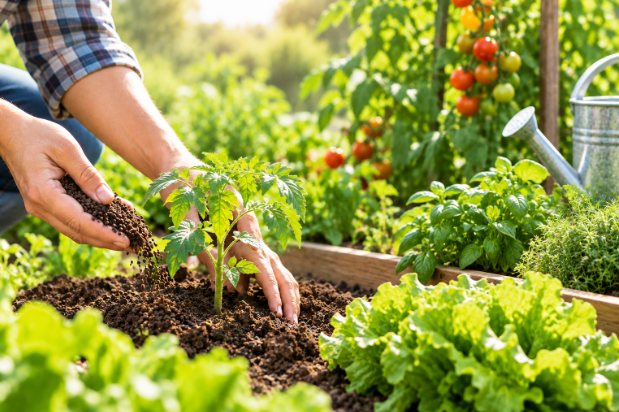
Healthy plant growth depends on more than sunlight and water. Plants need a steady supply of essential nutrients, while the condition of the surrounding soil influences how effectively roots can access those nutrients. Fertilizers can supplement soil fertility when plants require additional nutrition.
For gardeners considering organic plant fertilizer, understanding nutrient requirements, application methods, and product labels can help prevent both underfeeding and unnecessary fertilizer use. Organic gardening also places greater emphasis on maintaining healthy soil through practices such as composting, crop rotation, and appropriate nutrient management.
What Is Organic Plant Fertilizer?
Organic fertilizers are derived from natural sources such as plant materials, animal-derived materials, or mineral sources permitted under applicable organic production standards. They are different from synthetic fertilizers in their source and, depending on the product, the way nutrients become available to plants.
The USDA explains that organic crop production manages soil fertility through practices such as tillage, cultivation, crop rotation, cover crops, and approved nutrient inputs. The term “organic” on an agricultural product also has specific regulatory meaning when used in connection with USDA organic certification.
Gardeners should therefore distinguish between a product being marketed as natural or organic-focused and a product carrying a particular organic certification or listing. Reading the label is essential.
Why Does Soil Health Matter?
Fertilizer works within a larger soil ecosystem. Healthy soil provides roots with physical support, water, air, and access to nutrients. Organic matter can also contribute to soil structure and biological activity.
USDA guidance notes that successful organic gardening begins with healthy soil texture and structure. Compost and other appropriate amendments can improve the physical environment in which roots grow, although the right amendment depends on the existing soil and plants being cultivated.
This means fertilizer should not be viewed as a replacement for good soil management. A balanced approach combines appropriate nutrition with adequate moisture, drainage, organic matter, and suitable growing conditions.
Which Nutrients Do Plants Need?
The three numbers displayed on many fertilizer labels represent the product’s N-P-K analysis:
- Nitrogen (N): Supports leafy and vegetative growth.
- Phosphorus (P): Plays important roles in root development and plant energy processes.
- Potassium (K): Supports several physiological functions, including overall plant strength and development.
Plants also require secondary nutrients and micronutrients in smaller quantities. However, more fertilizer does not automatically mean healthier plants. Nutrient excesses can create problems just as deficiencies can.
The USDA Agricultural Marketing Service recommends using soil tests, plant tissue tests, plant condition, or crop-quality observations when determining whether additional micronutrients are needed in organic production.
How Should You Select a Fertilizer?
Start by identifying the plants you are growing and the condition of your soil. A product designed for vegetables may have a different nutrient balance from one formulated for flowering plants.
A suitable organic plant fertilizer should have clear labeling that explains its nutrient analysis, intended uses, application instructions, and any relevant certification or listing. Gardeners should follow the manufacturer’s recommended rate rather than assuming that a larger quantity will produce faster growth.
For example, WonderTree Organics lists a 7-7-7 formula specifically for vegetables and leafy greens. Its product information identifies nitrogen, phosphate, and potassium as components intended to support foliage, root development, plant strength, and productive vegetable growth.
When Should Fertilizer Be Applied?
Timing depends on the crop, growing medium, fertilizer formulation, and local growing conditions. Some fertilizers are incorporated into soil before planting, while others are applied around established plants during the growing season.
Slow-release products are designed to make nutrients available gradually rather than all at once. WonderTree’s neem-based products, for instance, are described as slow-release formulas, with application instructions that vary by product.
Gardeners should always follow the specific directions printed for the product being used. Applying fertilizer too frequently or at excessive rates can waste resources and may contribute to nutrient imbalances.
Can Organic Fertilizer Be Used in Vegetable Gardens?
Yes, suitable organic fertilizers can be used for vegetable gardens, provided the product is appropriate for the intended crop and applied according to its label.
Vegetables have different nutrient requirements throughout their growth cycles. Leafy greens generally produce substantial vegetative growth, while fruiting crops such as tomatoes and peppers also have nutritional demands associated with flowering and fruit production.
WonderTree Organics lists a dedicated vegetable and leafy-green formulation as well as separate tomato and other plant-specific formulas.
For gardeners choosing a vegetable fertilizer, the most useful comparison is not simply whether a product is labeled organic. The nutrient analysis, ingredients, application rate, crop suitability, and soil conditions should all be considered together.
What Role Can Neem-Based Fertilizers Play?
Neem cake is a plant-derived material made from neem seeds. Some fertilizer products use neem-based ingredients as part of their formulation.
WonderTree’s 100% Neem Cake product is listed as a 2-1-1 fertilizer and is identified by the company as OMRI Listed. Its instructions include mixing the material with soil and watering after application. The company also describes it as a slow-release source of nutrients.
Such products should still be used according to their individual labels. Certification or listing claims should also be checked at the product level rather than assumed to apply to every item from a manufacturer.
What Mistakes Should Gardeners Avoid?
Several common mistakes can reduce the effectiveness of fertilization:
- Applying fertilizer without considering soil conditions.
- Using more fertilizer than the label recommends.
- Choosing a formula without considering the crop.
- Ignoring nutrient deficiencies or excesses.
- Treating fertilizer as a substitute for healthy soil.
- Failing to water according to the product instructions.
- Assuming every product marketed as “organic” has the same certification status.
A soil test can be particularly useful when nutrient problems are unclear. It provides information that can help gardeners make more informed decisions rather than relying only on visible symptoms.
Conclusion
Choosing organic plant fertilizer is ultimately about matching the product to the plant, soil, and growing conditions. Gardeners should examine nutrient ratios, ingredients, application instructions, and certification claims before applying a product. Maintaining healthy soil through compost, appropriate cultivation, crop rotation, and other sustainable practices can complement fertilizer use. For anyone comparing a vegetable fertilizer, the best choice is one that provides appropriate nutrients for the crop and can be applied accurately according to its label. With thoughtful soil management and measured fertilization, gardeners can create conditions that support healthy growth while avoiding unnecessary nutrient applications.

Most Commented Posts