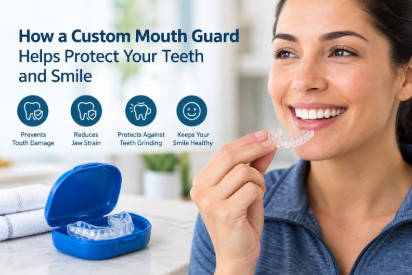
Protecting your teeth involves more than maintaining a regular brushing and flossing routine. Sports, recreational activities, nighttime grinding, and accidental impacts can all place additional stress on the teeth and surrounding tissues. A properly fitted mouth guard can provide an important layer of protection when dental injuries are a concern.
What Is a Custom Mouth Guard?
A custom mouth guard is a protective oral appliance designed specifically for an individual’s teeth and mouth. Unlike stock mouth guards, which come in predetermined shapes and sizes, custom appliances are fabricated using impressions of the patient’s dental structures.
The American Dental Association explains that they are typically fabricated in a dental office or laboratory using an individual’s dental impressions. Their customized design can provide a precise fit and allow the appliance to be adapted to the wearer’s needs.
Why Proper Fit Matters
A mouth guard needs to remain securely positioned to provide effective protection. An appliance that shifts easily can be uncomfortable and may not provide the same level of protection as a properly fitted device.
The ADA recommends properly fitted mouth guards for activities where there is a significant risk of dental or orofacial injury. An ideal mouth guard should remain comfortably and securely in place while providing a resilient protective surface over the teeth.
A custom appliance can therefore be particularly useful for people who have difficulty finding a comfortable fit with generic options.
Mouth Guards and Sports Protection
Contact and collision sports can expose the teeth, lips, cheeks, and other oral structures to impact. However, dental injuries are not limited to traditionally high-contact sports. The ADA also identifies activities such as gymnastics, skating, cycling, volleyball, and other recreational activities where oral injuries can occur.
Wearing a properly fitted mouth guard can help reduce the incidence and severity of sports-related dental injuries. It is especially important to use appropriate protection consistently during practices as well as competitions when the activity presents a meaningful risk of impact.
Custom Versus Over-the-Counter Options
Mouth guards are generally available in several forms, including stock, boil-and-bite, and custom-made options. Stock appliances are manufactured in standard sizes, while boil-and-bite products are softened and molded by the wearer.
Custom appliances are made from individual dental impressions and can be tailored to the patient’s mouth. The ADA notes that custom mouth guards can offer an optimal fit and greater adaptability, although they generally cost more than other options.
The most appropriate choice can depend on the individual’s activity, dental needs, budget, and recommendations from a dental professional.
Mouth Guards for Different Dental Needs
Although sports protection is one common reason for using a mouth guard, dental professionals may recommend oral appliances for other situations as well. People who regularly clench or grind their teeth may require a different type of appliance designed around their specific dental needs.
Because different appliances serve different purposes, patients should avoid assuming that a sports mouth guard and a nighttime dental appliance are interchangeable. A dentist can determine which type is appropriate based on an examination and the individual’s circumstances.
Caring for Your Mouth Guard
Regular cleaning helps keep a mouth guard in suitable condition. It should be cleaned according to the manufacturer’s or dental professional’s instructions and stored in an appropriate ventilated container when it is not being worn.
It is also important to check the appliance periodically for signs of damage, excessive wear, or changes in fit. Children and teenagers may need their appliances reviewed more frequently because their mouths and teeth are still developing.
When to Ask a Dentist About a Mouth Guard
A dental consultation can help determine whether a custom appliance is appropriate. This is particularly useful for athletes involved in activities with a risk of dental trauma, people who experience discomfort from generic mouth guards, or individuals who have specific dental concerns.
A dentist can assess the teeth and oral structures, discuss available options, and ensure that the appliance is properly designed for its intended purpose.
Conclusion
A properly fitted mouthguard can provide valuable protection against dental and oral injuries, particularly during sports and recreational activities where impact is possible. Maintaining good everyday oral hygiene and following professional guidance for treatments such as dental whitening treatment can further support a healthy, well-maintained smile. Its individualized fit can improve comfort, stability, and usability compared with generic options. Whether protection is needed for athletics or another specific dental concern, discussing the appropriate appliance with a dental professional from Sandwich West Dental Centre can help ensure that the chosen solution meets the individual’s needs.




Most Commented Posts