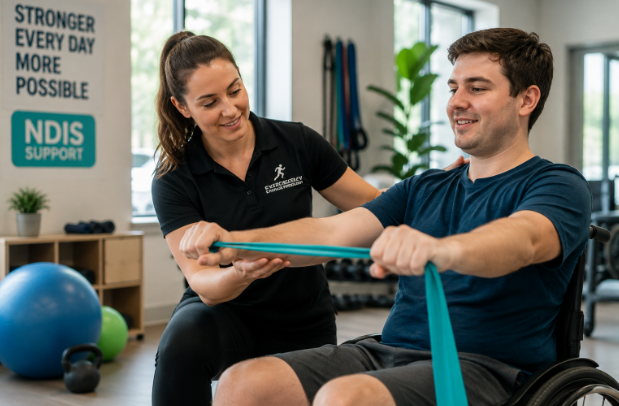
For many NDIS participants, exercise is not simply about fitness. It can be used in a structured way to support mobility, strength, balance, endurance, confidence, and the ability to complete everyday activities more independently. Exercise physiology NDIS services are designed around these functional goals, using individually planned exercise rather than a general gym program.
The NDIS currently recognises exercise physiology as a type of therapy support when it meets the scheme’s funding criteria, and qualified allied health professionals must deliver funded therapy supports.
Understanding how these services differ from ordinary exercise and how they can fit within a participant’s broader support plan can make the process easier to navigate.
What Is Exercise Physiology Under the NDIS?
An Accredited Exercise Physiologist is trained to use evidence-based exercise for people who may be living with disability, chronic conditions, injuries, or complex health needs.
Within exercise physiology NDIS, the focus is generally on improving functional capacity rather than simply increasing fitness for its own sake.
The NDIS identifies exercise physiology within physical wellbeing and therapy-related supports, depending on the participant’s plan and the purpose of the service. Current NDIS guidance also makes clear that funded therapy must relate to the functional impact of a person’s disability and meet the scheme’s funding criteria.
This means programs should connect clearly to individual goals.
How Is It Different From Personal Training?
Personal training and exercise physiology are not interchangeable.
A personal trainer generally focuses on fitness, strength, conditioning, or general physical activity. An exercise physiologist has university-level clinical training and can work with people who have more complex health and functional needs.
With exercise physiology NDIS, sessions may take into account:
- Disability-related limitations
- Medical history
- Mobility
- Balance
- Fatigue
- Pain
- Coordination
- Functional goals
- Current support needs
The NDIS separately identifies exercise physiologists and personal trainers within physical wellbeing support arrangements, reflecting their different qualifications and roles.
What Can an Exercise Physiology Program Include?
Programs are usually tailored rather than based on a fixed workout template.
An initial assessment can help identify strengths, movement limitations, functional priorities, and areas that may benefit from structured exercise.
A typical exercise physiology NDIS program may include exercises targeting:
- Strength
- Cardiovascular endurance
- Balance
- Coordination
- Mobility
- Functional movement
- Confidence with physical activity
Progress can then be reviewed and exercises adjusted as capacity changes.
The purpose is generally to make exercise relevant to everyday life rather than treating gym-based performance as the main outcome.
Why Are Functional Goals Important?
NDIS funding is centered on disability-related needs and functional outcomes.
That means a goal such as “improve leg strength” becomes more meaningful when connected to an everyday activity, such as standing from a chair, walking further, using stairs, or moving more confidently in the community.
Good exercise physiology NDIS planning should therefore connect individual exercises to practical goals.
Current NDIS guidance states that therapy supports must have sufficient evidence of good functional outcomes for the person’s disability in order to be fundable.
This makes goal setting an important part of the process.
Can Exercise Physiology Support Mobility?
Mobility involves more than walking distance.
It can include balance, transferring between positions, lower-body strength, endurance, and confidence moving through different environments.
An exercise physiology NDIS program may therefore use progressive exercises to build the physical capacity needed for daily movement.
For one participant, that might mean improving tolerance for community walking. For another, it could involve building strength for transfers or reducing fatigue during household activities.
The program should reflect the participant’s own priorities rather than applying the same mobility target to everyone.
Balance and Coordination May Also Be Addressed
Balance is a common functional concern for some people living with disability.
Exercise physiologists can incorporate exercises that gradually challenge stability and coordination while taking individual safety needs into account.
Within exercise physiology NDIS, this might involve supported standing, controlled weight shifting, stepping tasks, or other appropriate movements.
Progression should be gradual.
A participant should not be pushed into unstable exercises simply because they appear more advanced. The aim is to improve useful control while keeping the program appropriate to the person’s current ability.
Strength Training Can Be Highly Individualised
Strength work is not limited to heavy weights.
Resistance can come from body weight, bands, machines, free weights, or supported functional movements.
In an exercise physiology NDIS setting, the exercise physiologist may select resistance based on the participant’s mobility, coordination, tolerance, and functional goals.
For example, strengthening the legs may support transfers or walking, while upper-body exercises may help with pushing, pulling, or using mobility-related equipment.
Exercise selection should always have a clear purpose rather than being added simply because it is commonly used in a gym.
Endurance Can Affect Everyday Independence
Fatigue can limit participation in daily activities.
For some participants, improving cardiovascular endurance may help them tolerate longer periods of walking, household activity, recreation, or community participation.
An exercise physiology NDIS program can introduce endurance work progressively rather than expecting participants to perform long sessions immediately.
This might include walking, cycling, supported cardiovascular equipment, or repeated functional tasks depending on individual ability.
The emphasis should be on building sustainable capacity without ignoring fatigue, symptoms, or recovery needs.
Where Can Sessions Take Place?
Exercise physiology does not always have to occur in one type of setting.
Depending on the participant, provider, and plan, sessions may take place in a clinic, gym-based environment, home, or community setting.
The referenced service information notes that options can include clinic, home, and community-based delivery, with home visits available subject to availability for participants facing mobility or transport barriers.
This flexibility can be useful within exercise physiology NDIS because the most appropriate environment depends on functional goals.
Sometimes practising in a real-world setting is more useful than working only in a clinic.
How Is Progress Usually Tracked?
Progress should be measurable where possible.
An exercise physiologist may monitor changes in strength, endurance, balance, movement confidence, or performance of functional tasks.
For exercise physiology NDIS, progress reporting can be particularly useful because it helps show whether the intervention is supporting the goals identified in the participant’s plan.
Measures do not always need to be highly technical.
For example, being able to walk further before resting or complete a daily task with less assistance can be meaningful evidence of improvement.
The most useful measures are those connected to the participant’s real life.
Does Every NDIS Participant Automatically Qualify?
No.
Having an NDIS plan does not automatically mean every therapy or exercise service will be funded.
Current NDIS guidance states that therapy supports need to satisfy the scheme’s funding criteria and must relate appropriately to disability-related functional outcomes.
Participants should therefore check their current plan and funding arrangements before beginning exercise physiology NDIS services.
Support categories and claiming arrangements can also change over time, making current plan documentation and NDIS guidance more reliable than older information online.
Why Provider Qualifications Matter
NDIS-funded therapy supports need to be delivered by appropriately qualified professionals.
The NDIS states that therapy providers must be qualified and either registered through AHPRA or accredited by the relevant professional body for self-regulated professions.
For exercise physiology, current NDIS pricing guidance identifies Accredited Exercise Physiologists associated with Exercise and Sports Science Australia as the relevant professional type.
When choosing exercise physiology NDIS support, participants should therefore confirm professional qualifications rather than assuming every fitness provider offers the same service.
Conclusion
Exercise physiology NDIS support is best understood as structured, goal-oriented exercise designed to improve functional capacity related to disability. Depending on individual needs, it may focus on strength, mobility, endurance, balance, coordination, confidence, or greater independence in everyday activities. The most effective programs are personalised, measurable, and connected directly to the participant’s own NDIS goals rather than built around generic fitness targets. For example, someone seeing a physio in Leichhardt may be working on rehabilitation, mobility, pain, or a specific physical impairment, while an exercise physiologist may focus more on building ongoing physical capacity through structured exercise. Participants should review their current plan, confirm provider qualifications, and understand how exercise physiology fits alongside other allied health supports before beginning. With the right structure and realistic goals, exercise can become a practical tool for building capacity rather than simply another workout.






Most Commented Posts