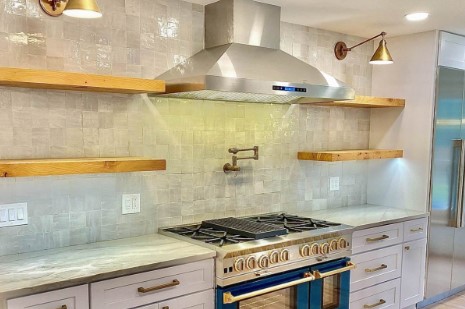
Large cooking surfaces require ventilation systems capable of capturing smoke, grease, steam, and cooking odors across a broad area. For homeowners with spacious kitchens, selecting the right hood involves more than matching its width to the range. Airflow capacity, installation style, ducting, construction materials, filtration, controls, and maintenance all influence how effectively a ventilation system performs. A 60 kitchen hood can be particularly useful for large ranges and expansive cooking areas, but the best choice depends on how the kitchen is designed and how frequently high-heat cooking takes place.
Match the Hood Width to the Cooking Surface
The first consideration should be coverage. A ventilation hood needs to adequately cover the cooking surface so rising contaminants can be captured before they spread throughout the kitchen.
A 60-inch hood is designed for larger cooking installations and can work well with wide ranges, cooktops, and other high-capacity configurations. Proline’s current 60-inch collection includes wall-mounted, island, under-cabinet, and insert options, giving homeowners several ways to match ventilation with their kitchen layout.
Before choosing a model, measure the cooking surface and available installation area carefully. Cabinet dimensions, ceiling height, surrounding walls, and the location of existing ductwork can all affect the appropriate configuration.
Determine the Right Airflow Capacity
CFM, or cubic feet per minute, is an important specification because it indicates the amount of air a hood can move. However, maximum airflow is not automatically the best choice for every kitchen.
Current 60-inch models include options ranging from approximately 1,000 CFM to 2,000 CFM, depending on the configuration. Some models use dual blowers to provide higher airflow for demanding cooking applications.
Homeowners should consider the type of cooking they regularly perform. Frequent grilling, searing, wok cooking, or other high-heat techniques may require greater ventilation capacity than lighter everyday cooking.
Choose Between Wall and Island Installation
Kitchen layout plays a major role in determining hood style. A range positioned against a wall can typically use a wall-mounted or under-cabinet configuration, while a cooking surface located within an island requires an island hood.
The current 60 kitchen hood collection includes both wall-mounted and island models, with several options providing ducted ventilation and stainless-steel construction.
Island installation also requires careful consideration of ceiling structure and duct routing because the hood is suspended away from a wall. Planning these details before purchasing can help prevent installation complications.
Consider Construction and Filtration
Material quality can affect durability and long-term maintenance. Stainless steel is commonly used for large ventilation systems because it provides a durable surface that can be cleaned regularly.
Some 60-inch models are available in 430 stainless steel, while upgraded versions use 304 stainless steel. The latter can be particularly useful in environments where additional corrosion resistance is desirable.
Filters also deserve attention. Baffle filters can help capture grease while offering a practical design for routine cleaning. Dishwasher-safe baffle filters are available on several professional 60-inch models, making ongoing maintenance more convenient.
Plan the Ductwork Before Installation
A powerful hood needs an appropriate exhaust pathway to perform effectively. Duct size, length, bends, and configuration can influence airflow and overall ventilation performance.
Ducted models are common throughout the 60 kitchen hood category, while certain under-cabinet models can also be converted to ductless operation.
Ideally, duct planning should happen before the kitchen installation begins. This allows homeowners and installers to account for the hood’s airflow requirements, available space, and the shortest practical route for exhausting air outside.
Look for Practical Features
A large ventilation system should be convenient to operate as well as powerful. Multiple fan speeds allow users to adjust airflow according to cooking intensity, while LED lighting can improve visibility over the cooking surface.
Easy-to-clean filters and accessible controls can also make a noticeable difference during everyday use. Current 60-inch models include features such as multiple speed settings, LED lighting, stainless-steel baffle filters, and single or dual blower configurations.
Create a Balanced Ventilation System
A kitchen hood can provide broad coverage and substantial airflow for large cooking areas, but its effectiveness depends on proper sizing, installation, ductwork, and maintenance. For those comparing different ventilation configurations, a 30-inch island range hood may be worth considering when the cooking surface and available kitchen space call for a smaller island-mounted solution rather than a full-width system.




Most Commented Posts