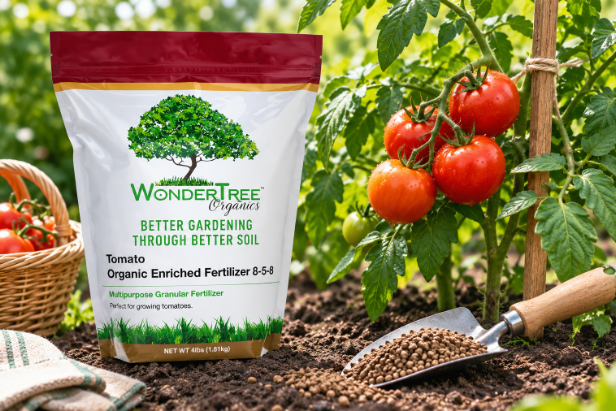
Growing healthy tomatoes requires more than regular watering and plenty of sunshine. Tomato plants need balanced nutrition throughout their development, from early leaf growth to flowering and fruit production. The quality of the soil, the availability of essential nutrients, and consistent care all influence how well plants grow and produce fruit. Choosing an organic-enriched tomato fertilizer can help gardeners support these nutritional needs while incorporating organic gardening practices into their growing routines.
Tomatoes use several essential nutrients at different stages of growth. Nitrogen supports leafy development, phosphorus contributes to root development and energy transfer, and potassium helps regulate water movement and supports overall plant function. Secondary nutrients and micronutrients also contribute to healthy growth, although their importance depends on soil conditions and existing nutrient levels.
Why Nutrient Balance Matters for Tomato Plants
Tomato plants require different nutrient proportions as they progress through their growth cycle. Young plants need sufficient nutrition to establish strong roots and develop healthy foliage. As plants mature, they require continued support for flowering, fruit formation, and fruit development.
Too much nitrogen can encourage excessive leafy growth at the expense of fruit production. Conversely, inadequate nutrition may result in slow growth, pale leaves, or reduced yields. However, these symptoms can also indicate watering problems, root damage, unsuitable soil pH, or disease, so gardeners should assess the growing conditions before adding fertilizer.
An organic enriched tomato fertilizer may provide a combination of nutrients intended to support plant development. The precise benefits depend on its formulation, nutrient availability, and the condition of the growing medium. Checking the product’s guaranteed nutrient analysis helps gardeners understand what it supplies and whether it suits their plants’ needs.
How Organic Fertilizers Support Soil Health
Organic fertilizers can contribute to a gardening approach that focuses on maintaining soil quality alongside plant nutrition. Depending on their ingredients, they may supply nutrients from naturally derived materials and support biological activity in the growing medium.
Healthy soil contains microorganisms that help break down organic matter and influence nutrient availability. Organic materials can also contribute to soil structure and water retention, although these benefits vary by ingredient and application rate.
Gardeners should remember that organic does not automatically mean risk-free or suitable for every plant. Some products release nutrients gradually, while others provide nutrients more readily.
Best Practices for Fertilizing Tomato Plants
Effective fertilization begins with understanding the growing environment. Before applying any product, consider the soil or potting mix, the plant’s growth stage, and whether previous fertilizer applications have already supplied sufficient nutrients.
The following practices can help maintain healthier tomato plants:
- Assess the growing medium. Soil testing can reveal nutrient deficiencies, excessive nutrient levels, and pH conditions that may affect nutrient availability.
- Follow application instructions. Use the recommended quantity and frequency provided on the fertilizer label. Avoid assuming that higher amounts will produce better results.
- Fertilize at appropriate stages. Match nutrient applications to the plant’s development and the product’s directions rather than following an inflexible schedule.
- Maintain consistent watering. Both overwatering and underwatering can interfere with nutrient uptake. Ensure containers have adequate drainage and garden soil does not remain waterlogged.
- Monitor plant health. Observe leaf colour, growth patterns, flowering, and fruit development. Investigate persistent problems before increasing fertilizer applications.
Common Fertilization Mistakes to Avoid
One frequent mistake is treating fertilizer as a solution to every plant problem. Yellow leaves, weak growth, and poor fruit production can result from multiple causes, including inadequate light, temperature stress, pests, and irregular watering.
Another mistake is applying fertilizer without considering existing soil nutrients. Repeated applications may create imbalances that affect plant performance. Testing the soil and following product-specific guidance can help prevent unnecessary additions.
Gardeners should also avoid placing concentrated fertilizer directly against stems or roots unless the product instructions specifically permit it. Incorrect placement or excessive concentration can injure plant tissue.
Conclusion
Healthy tomato production depends on balanced nutrition, suitable growing conditions, and consistent plant care. For gardeners also exploring a good fertilizer for indoor plants, the same principles apply: identify the plant’s nutritional needs, consider the growing medium, and choose a formulation suited to the species. Selecting an appropriate fertilizer, following application instructions, and monitoring plant development can help gardeners support steady growth while avoiding common nutrient-related problems.



Most Commented Posts